|
The Ionoluminescence (IL) method
The Ionoluminescence (IL), also known as Ion Beam Induced Luminescence (IBIL) is a luminescence phenomenon, which is caused by energetic ions penetrating matter. The IL method was developed simultanously at Lund University (Sweden) and MARC Melbourne (Australia) a few years ago.
Contents:
Why using the IL method ? A Brief Introduction in the Fundamentals of IL The IL detection system Examples Literature
Why using the IL method ?
The light emitted under ion irradiation originates from electron transitions and recombination processes within the outer electron shells of the sample atoms. The energy levels of these electron shells are affected by the chemical bondings of the atom. Therefore the ionoluminescence method can provide information about the chemical form of elements (speciation), which cannot be obtained by other ion beam analytical methods (e.g. PIGE, PIXE, RBS). It also allows the detection of Mn and Rare Earth Elements in host minerals (e.g. apatite) with a minimum detection limit of a few ppm (mg/g) [1]. In material sciences the IL method can be applied to study the influence of ion beam modification (e.g. production of intrinsic defects) on the luminescence properties of solids.
A Brief Introduction in the Fundamentals of IL
What is luminescence ? Luminescence is the nonthermal emission of light by matter, which was excited by an energy absorption process (therefore scattered light or Tcherenkov-radiation do not belong to luminescence). According to the time interval t, in which the luminescence vanishes, after the excitation source has been removed, the luminescence can be subdivided in fluorescence (t ~ 10-8 s) and phosphor- escence (t >> 10-8 s).
How is the ionoluminescence generated ? The interactions between the ions penetrating the sample and the sample atoms lead to a energy deposition within the sample. The generation of luminescence can be explained by the following processes:
|
1.
|
Ionization of sample atoms due to the energy deposition in the sample
|
|
2.
|
Recombination of electrons and ionized atoms
|
(a)
|
the lattice absorbs the released ionization energy
|
|
(b)
|
excitation of the "optical system"
|
|
|
3.
|
De-excitation due to radiationless recombinations of excited states
|
|
4.
|
Luminescence due to recombinations of excited states.
|
The luminescence can be caused by the sample material itself (intrinsic) or by impurities in the sample (extrinsic), which then acts as a host material for the impurities.
Intrinsic luminescence The electronic structure of crystalline solids can be described by energy bands, which provide delocalized excited states for electrons. Defect centers (e.g. imperfections in the crytal lattice, colour centers, impurities) can locally modify the electronic structure of the solid, yielding to the presence of localized excited states (e.g. creation of energy levels in the band gap of semiconductor materials by doping). The transitions resulting in intrinsic luminescence can be distinguished between:
Optical transitions from delocalized excited states
- Recombination of free electrons in the conduction band with holes in the valence band (direct and indirect transition)
- Recombination of excitons (electrons and holes are bound by Coulomb-interaction, thus forming electron-hole-pairs)
Optical transitions from localized excited states
- Recombination of excitons bound to defect centers (e.g. self trapped exciton (STE) in SiO2)
- Electron Transitions from excited states of a defect center to its ground state (e.g. F-center in sapphire (Al2O3))
- Transition of a charge carrier from a delocalized state (e.g. in the conduction band) in a localized state of a defect center
The shape and the Full Width at Half Maximum (FWHM) of the peaks and bands in the luminescence spectrum depend on thermal effects (e.g. energy distribution of free charge carriers) and the strength of the interaction between the electrons and phonons, which participate in the optical transition. Assuming low temperatures and weak electron-phonon-interactions the luminescence spectra consist of sharp peaks and narrow bands. Strong electron-phonon-interactions yield to a broadening of the peaks and bands in the spectra.
Extrinsic luminescence Most of the mineral samples in geosciences contain impurities such as transition metal ions or rare earth elements in their crystal structure. The pure minerals often show no luminescence at all, but impurities even at concentrations of a few ppm can cause a remarkable luminescence, when the host mineral is excited. Normally different types of impurities are present in the host mineral and interact with each other. Depending on their behaviour in the mineral, the impurities can be subdivided in activators, co-activators (sensitizers) and quenchers [2].
Activator
An impurity, which causes the luminescence of the host mineral, acts as an activator. It is also calledluminescence center (e.g. Mn2+ in willemite, Eu3+ in apatite).
Co-activator
Sometimes an impurity can only activate luminescence, if another certain impurity is present in the mineral. The latter one is called co-activator or sensitizer (e.g. Pb2+ is a co-activator for Mn2+ in calcite). The process of co-activation can be explained by an energy transfer from the co-activator to the activator(see Fig.1).
Quencher
Sometimes the luminescence of an activator is suppressed (quenched), if another certain impurity is present in the mineral. This impurity is called quencher (e.g. Fe2+ is a quencher for Mn2+ in carbonates). The quenching process can be explained by a modification of the energy levels in the host mineral, which makes the luminescence activation very inefficient. In case an activator quenches the luminescence of its co-activator, the activator also behaves like a quencher. At higher activator concentrations the luminescence can be quenched by the activator itself due to resonant absorption processes. This quenching process is called selfquenching.
Fig.1: Energy transfer process between co-activator and activator (strongly modified from Marfunin)
The IL detection system
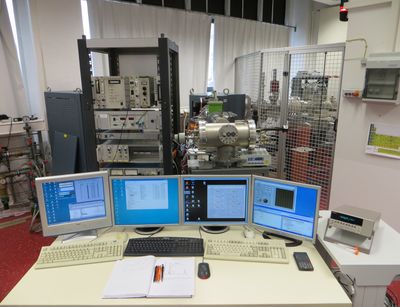
The IL detection system was established at the external ion beam facility of the 2 MV van de Graaff accelerator. With this system one can get IL spectra and IL images from the sample region luminescing under ion irradiation [3].
Spectrometer
- MONOSPEC 27 SPEKTROGRAPH manufactured by JARRELL-ASH (SCIENTIFIC INSTRUMENTS INC.) with two gratings (150 g/mm and 1200 g/mm)
- SCCD single line photodiode array manufactured by SOLITON (2048 channels, peltier-cooled)
- Detectable wavelength range: 350 nm < l < 1100 nm
Imaging system
- NIKON SMZ-2T microscope with NIKON TV LENS C-0,45x tv-adapter
- KAPPA CF 20 DXC colour camera with 3-CCD-chips (H x V = 752 x 582 pixels, peltier-cooled)
Examples
IL investigation of sapphire (Al2O3)
Literature
- [1] D.J.Marshall. Cathodoluminescence of Geological Materials. Unwin Hyman, Boston (1988).
- [2] A.S.Marfunin. Spectroscopy, Luminescence, and Radiation Centers in Minerals. Springer, Berlin (1979).
- [3] D.Spemann. Diploma Thesis, Universität Leipzig (1998). (siehe Zusammenfassung)
|