Projects
Methods
Laboratories
Introduction:
Our division is engaged in the fields of life and material sciences with ion beam and nuclear probe techniques.
The research of the ion beam lab is focused on two main fields: materials sciences (analysis and modification) and life sciences. The latter one includes quantitative microscopy of elemental distributions in biological samples (mainly for neuroscience), the targeted irradiation of living cells with counted single ions for low dose radiobiology, and a new ion beam based biotechnological method to create areas of confined cell growth for patterned cell cultures. For material analysis we use the standard ion beam analytical methods with the broad as well as the focussed beam, for wich we successfully introduced channeling techniques on the micrometer scale. We could also extend the capabilities for 3D-density and elemental analysis by introducing the limited angle tomography for the scanning microbeam.
The high energy proton or helium-ion beam is also used to modify the physical properties of solids (resists, semiconductors and carbon based materials) by ion irradiation. We create high aspect ratio and free standing microstructures in positive and negative resists and in several types of semiconductors. In carbon based materials we are able to change the electronic properties, which is highly interesting for the study of intrinsic ferromagnetism in these systems.
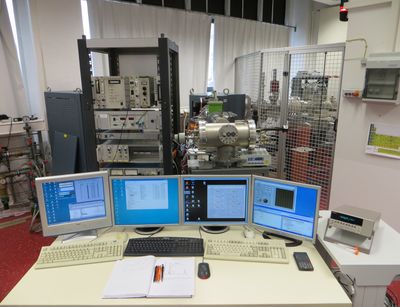
Our working horse is the high-energy ion-nanoprobe LIPSION with specifications which are unique in Germany and belongs to the best systems worldwide. A careful re-adjustment of the ion optical system lead to a major improvement which opened new high current applications that are usually not feasible on focussed microbeams. Over the last ten years, since the first beam in 1998, we have developed to one of the leading high-energy ion-nanobeam laboratories in the world. This was recognized by the international community by awarding us to host the next international conference on nuclear microprobe technology and applications ICNMTA in 2010.
We have also a longterm expertise in perturbed angular correlation of g-rays (TDPAC). This method is used to determine the nuclear quadrupole interactions of materials like TiO2 bulk and TiO2 nano-particles and nano-wires. TDPAC is especially suited to assess in-vitro the solubility of these nano-particles in body fluids without separation of the particles and solution. This information is absolutely necessary to determine probable health risks after incorporation of nano-particles.