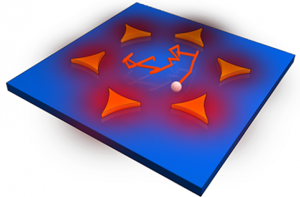
 Fluorescence microscopy delivers powerful tools to access either the photophysical properties of single molecules or to measure other physical quantities with the help of them. What is missing in the field of single molecule detection are methods to manipulate such nano-objects in solution allowing even to bring a controlled number of molecules together to study their interaction, aggregation or chemistry. The group develops experimental methods to localize and manipulate single molecules and nano-objects in solution. They are based on the generation of local temperature gradients. While an increased temperature at first glance enhances fluctuations, temperature gradients induce interfacial flows which cause the migration of objects. This is known as thermophoresis.
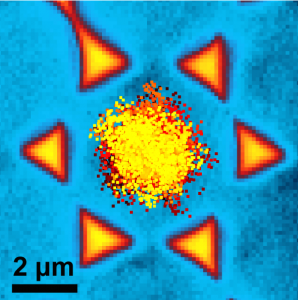
Thermophoresis causes in most of the cases a migration from the hot to the cold due to interfacial flows trigged by a temperature gradient along the surface of an object. Point heat sources in a thermal bath create temperature profiles which decay with the inverse distance from the heat source. Their temperature gradients can be very strong and reach easily 109 K/m. Such heat sources are therefore repulsive points for objects suspended in a liquid. If they are arranged appropriately, they form spatial temperature profiles which allow the trapping of single nano-objects in solution.
The group has demonstrated that metallic nanostructures are well suited as nano-heat sources to generate steady state temperature profiles in solution. The temperature profiles form the analogue of a potential energy landscape that localizes single nano-objects in solution [1].
Trapping of Single DNA Molecules in Dynamic Temperature Fields
Fluctuation Theorems in Dynamic Temperature Fields
Manipulation in Dynamic Temperature Fields
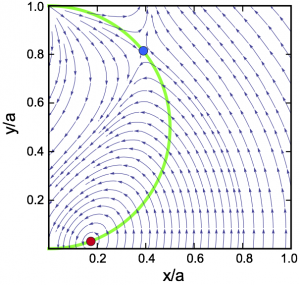 Heat diffusion, which is the major heat conduction mechanism in liquids, is very fast. It is in general almost 4 orders of magnitude faster than mass diffusion. Thus, temperature gradients are quickly switchable on time scales of a few microseconds. The group has shown in collaboration with Prof. Würger from the Universite Bordeaux I that dynamic temperature fields may be used in conjunction with thermophoresis to trap and manipulate particles in solution. A rotating heat source in a liquid generates a rotating repulsive temperature field which is able to trap and confine particles under certain conditions [2]. The motion of the trapped object can then be separated into a macro- and micro-motion, which is reminiscent of the motion of ions in a Paul trap.
Arrays of Multiple Traps