
| |

|
|
600 Years of Art at the University
Leipzig –
Rediscovering the Collection
STUDIENSAMMLUNG Ritterstrasse 26 (Rektorat)
04109 Leipzig
Opening Hours:
Monday 11-15 h
Pressedownload |
 |
german |
 |
 |
 |
 |
 |
|
|
|
The Art Collection
The University Art Collection (Kunstsammlung) comprises European
paintings, sculptures, works on paper as well as objects
of the applied arts from the High Middle Ages into the
present. In many ways, the collection reflects six hundred
years in the history of Germany’s second oldest university.
Rather than being collected for museum purposes, the holdings
gradually grew over time and are significant both as an
ensemble and for numerous important pieces. The exhibition
on the ground floor of the Rektoratsgebäude (Rectorate,
Ritterstraße 26) offers visitors a synopsis of the
history of the alma mater as well as a representative cross-section
of the collection.
The Early Period
Reformation and Baroque
The State University
Contemporary Art
|
 |
 |
 |
 |
 |
|


|
|
The Early Period
Historically the Universität Leipzig (“Alma mater
Lipsiensis”) is an offshoot of the Charles University
in Prague. After Masters and students of German origin had
left Prague – due to what they considered political
oppression – a new university was founded in Leipzig
in 1409 with the support of the Margraves of Meißen
and the permission of the Pope. Frederic IV, also known as
the “Quarrelsome”, and Wilhelm II granted them
property and the right to self-administration. This special
status is symbolised in the Art Collection by “insignia”,
such as the pair of sceptres (1476) [3] and the rector’s
small seal (1592). Following the Prague example, the new
university was likewise structured on the principle of four
faculties and four so-called “nations” of Meißen,
Saxony, Bavaria and Poland. They are reflected in four painted
shields of the 17th century, which originally decorated the
university hall (“Nationenstube”).
Today, many aspects of the history of the University can
only be found in its Art Collection. Practically no trace
is left of the early university’s original buildings,
as they were continually being rebuilt in more modern styles
and on a grander scale. The oldest college buildings were
located in the south-western part of the medieval city, between
the Schlossgasse and the Petersstraße, where the city
council had allocated buildings for the use of graduates
even before the official founding of the university. Later
expanded to the “Kleines Fürstenkolleg”,
these buildings housed the Faculty of Law from 1508 onwards
(first called the “Petrinum” and referred to
as the “Juridicum” since 1881). The main campus,
however, was situated on the eastern rim of the medieval
city, in the “Latin Quarter” between the city
wall (now the Goethestraße) and the Ritterstraße.
The complex of buildings became the seat of the Faculty of
Arts (artes liberales). The new campus included the “Großes
Fürstenkolleg” complete with dormitories (“Bursen”),
a large heated lecture hall (“Vaporarium”), which
also served as an assembly hall (“Nationenstube”),
as well as various colleges, e.g. the “Kleines Colleg” and
the “Rotes Colleg”.
|
 |
 |
 |
 |
 |
|


|
|
Reformation and Baroque
The introduction of the Reformation in 1539 entailed the
donation of even larger premises. In 1543 Grand Duke Moritz
bequeathed the newly secularised Dominican monastery of St.
Paul, south of the Grimmaische Straße,
now the area between the Grimmaische Straße, the Universitätsstraße,
Augustusplatz and the Moritzbastei. Numerous important medieval
works of art in the collection testify to the wealth and
culture of the former
monastery, such as the life-size wood sculpture of St. Thomas
Aquinus Teaching [8] and a double-sided painted altar piece,
both completed around 1400. The late 15th century high altar
of the Paulinerkirche is exhibited in the Thomaskirche as
a loan from the University to the church. The close ties
between the university and the Reformation movement are documented
in numerous portraits of Luther and Melanchton, paintings
with Protestant iconography, such as “Christ and the
Children” from the workshop of Lucas Cranach the Elder
[4] and painted epitaphs such as the one for Johann Goritz
dating from 1553.
For the growing University, the acquisition of the monastery
library represented a notable improvement in teaching conditions.
At the same time the new premises provided the much-needed
space for lecture halls, refectories and dormitories. Founded
in 1240, the Paulinerkirche was architecturally re-modelled
according to Protestant ideas and solemnly inaugurated as
the university church in 1545. Its spacious interior served
not only for disputations and graduation ceremonies, but
also as the burial site for the university elite, a practice
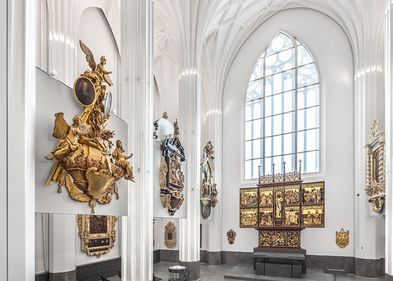
that continued into the late 18th century. In this tradition,
an important ensemble of epitaphs developed over the centuries,
which continued to inspire pride and confidence in later
generations. In 1968, however, communist rulers decided to
tear down the church to make room for socialist “urban
development”. Before the church was literally blown
up, many works of art could be saved by dedicated citizens.
The current exhibition presents a selection that has been
restored, yet a great many pieces still await restoration
for display in the new university hall/church on its original
site (expected completion in 2009).
The Post-Reformation history of the University is also reflected
in numerous portraits of professors. The “Ordinariengalerie” of
the Law School [7] includes portraits of department heads
from the 16th to the 19th century and is the only systematically
planned gallery of professors at the university. From the
middle of the 17th century onwards, an increase in portrait
donations from private benefactors is to be noted, many of
which were gifts to the University Library. Of particular
interest to art historians is the late 18th century Gallery
of Friendship. The collection consists of portraits commissioned
by the publisher and bookseller Phillipp Erasmus Reich of
Leipzig. Reich had associated with many famous Enlightenment
writers, artists and philosophers such as Moses Mendelsohn,
Lessing and
Sulzer from Leipzig or Lavater from Zurich. Predominantly
painted by
Anton Graff, the pictures included several university professors,
for example C. F. Gellert and J. A. Ernesti.
The so-called “deposition instruments” are of
special importance for the history of student life at the
university because they are relics of an ancient initiation
rite for incoming students. The notion derives from the Latin
term depositio cornu, i.e. the “removal of the horns”.
An incoming student at that time had to don a hat with horns,
symbolic of his uncouth, Dionysian nature, the forcible removal
of which symbolised his passage into civilised society. Moreover,
the student was “groomed” with oversize combs,
razors, axes and planes. After repeated cases of injuries
and even death, the initiation was finally abolished in 1719.
Similar rites were common at many universities throughout
Europe, but the necessary “tools” have only survived
in Leipzig.
|
 |
 |
 |
 |
 |
|


|
|
The State University
From 1830 onwards the Universität Leipzig began developing
into a modern state university. The new beginnings went hand
in hand with an ambitious building spree, which is documented
in the collection through various cityscapes on paper. Between
1830 and 1836, the first main building named “Augusteum”,
based on the designs of A. Geutebrück, was built on
the Augustusplatz. Its sculptural decoration by E. Rietschel
(1801 – 1864), for instance the tympanon on the façade
and the cycle of twelve reliefs for the university hall,
was largely destroyed in 1944, but an important architectural
fragment in the shape of the monumental entrance gate called
the “Schinkelportal” has survived. The middle
of the 19th century also saw the construction of new institute
buildings both on the premises of the monastery and in the “Academic
Quarter” on the city’s south-eastern periphery,
amply documented in etchings and lithographs. The years around
1900 saw the advent of yet another building campaign. Between
1892 and 1898 the original Augusteum by Geutebrück was
re-modelled along historistic lines by A. Roßbach [6],
adhering to the classical style of his predecessor. In addition
to a new façade towards the Augustusplatz, the building
was furnished with an impressive foyer and a much larger
university hall. In the exhibition, two alternative designs
are shown as models. In a second phase, the façade
of the church was likewise re-modelled, however in the Neo-Gothic
style.
The university collection also contains a large number of
works on paper, drawings, engravings and other types of prints,
the majority of which date from the 19th century. One group
of prints and drawings is of particular importance because
it includes works by various members of the Genelli-family,
e.g. Buonaventura, Hans Christian and Camillo Genelli. The
large legacy of scientifically valuable drawings and watercolours
by W. G. Tilesius von Tillenau are documents of early 19th
century natural history and ethnography. Made during a journey
around the world with a Russian expedition led by A. J. Krusenstern
between 1803 and 1806, they illustrate landscape, peoples,
as well as flora and fauna mainly of China and Japan. In
addition, the holdings include an extensive collection of
historical “Bilderbögen” (early printed
illustrations in popular publications).
Most of the interior decoration of the “Augusteum” was
however destroyed in World War II. The monumental mural
painting The Flourishing of Greece (1907 – 1909)
in the auditorium by the symbolist painter and sculptor
Max Klinger of Leipzig was lost. In the years around 1900,
the university had particularly close ties with Klinger
and commissioned him to produce several works. In the exhibition
this special relationship is attested to by Klinger’s
marble bust (1908) of the psychologist and former professor
Wilhelm Wundt. Some pieces of the interior decoration of
the Augusteum have survived, such as the sculpted portrait
bust of the art historian Anton Springer [9] signed by
Carl Seffner and dated 1892. Vogel von Vogelstein’s
oil painting (1841) of Gottfried Hermann, professor of
classical philology, is just one example of a representative
collection of painted portraits from the 19th century.
|
 |
 |
 |
 |
 |
|


|
|
Contemporary Art
After the reopening of the university in 1946, it was re-modelled
into a socialist university and renamed the Karl Marx University
in 1953. As a consequence, the collection also includes a
number of works in the style of socialist realism. After
the scandalous demolition of the university church in 1968,
the socialist re-modelling of the Augustusplatz entered a
new phase. Even the works of art commissioned on the occasion,
such as W. Tübke’s mural painting entitled “The
Working Class and the Intelligentsia” and the monumental
bronze relief entitled “Departure”, both part
of the modern complex on the sites of the main building and
the church, adhered to ideological precepts. From 1970 onwards,
the University commissioned painted portraits of several
of its rectors, such as
G. Mayer by H. Wagner [10]. From the District Council (Rat
des Bezirkes), an administrative body controlled by the socialist
party, the university received works of art as loans that
have remained in the collection. After German reunification
in 1989, the university inherited the Art Collection of the
Athletic College (“Deutsche Hochschule für Körperkultur
und Sport” or DHfK) relating to the world of sports,
including the “Long Jumper” by W. Sitte. Apart
from the bequests of artists, such as H. E. Strüning
and
R. Oelzner, a number of works by the protagonists of the
Leipziger Schule could be acquired, for example W. Mattheuer,
W. Tübke, B. Heisig and H. Zander [12]. Acquisitions
presently focus on works on paper, in particular prints by
contemporary artists from Leipzig, where such work has a
strong tradition.
|
 |
 |
 |
 |
 |
|
|
|
Pressedownload
Hier können sie den Ausstellungsflyer als PDF-Datei
herunter laden.
Download (pdf,
890 kB)
|
|
|